
How to Construct a Conspiracy Theory
The Referee-Gate that Probably Isn't

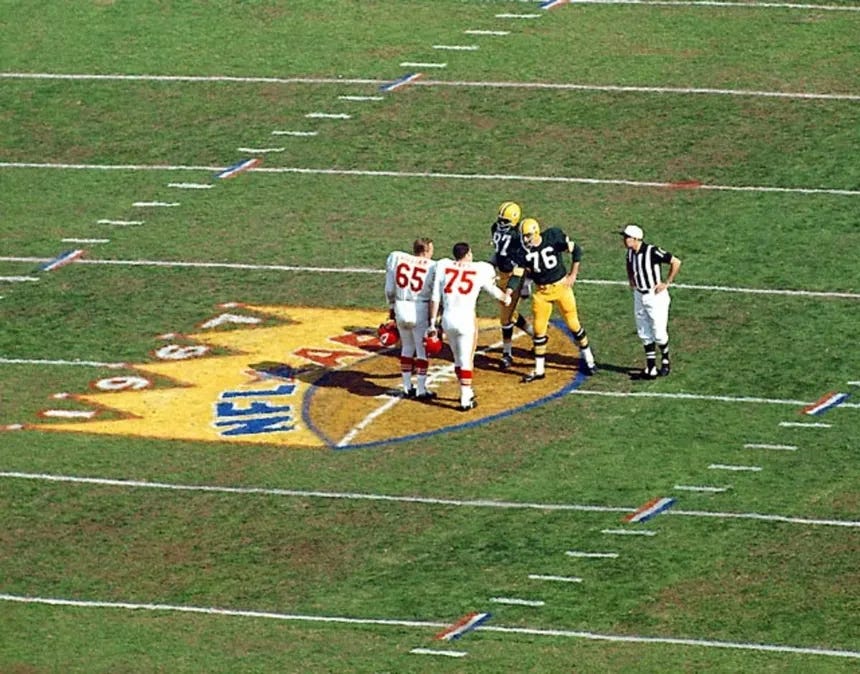
Recently I shared one of my crankiest takes with the world:
I expanded on it in other replies.
I came by this opinion after watching the 2023 Super Bowl, between the Chiefs and Eagles. Popular backlash against this was that the game was gifted to the Chiefs by the refs, who made the surprising move of calling a holding penalty agains the Eagles on a key down. Since holding is called in the NFL the way traveling is called in the NBA1, this felt like a violation to Eagles fans.
What they had forgotten were the two ridiculous calls in the third quarter. Within minutes, the refs had two wildly divergent decisions on what “possession of a catch” meant. The Eagles won both of these calls. I reckoned the holding was a scale-balancing, which I have heard the refs do sometimes, without ever fully admitting it.
Now, of course, NFL fans have always believed the refs are garbage, especially when their team loses. So it’s not difficult to get people to agree that the zebras are calling the game according to a separate set of orders. I can even come up with a plausible theory to explain exactly why and how it is done. Behold:
Football is a short season: 16 weekly games, 3-4 weeks of playoffs, and one championship game. That’s not a lot of opportunity to sell tickets, so the bulk - 62% -of the NFL’s revenue comes from “national revenue” which is what the NFL likes to call “the league’s media rights, sponsorships, events, licensing and other businesses”2. Only 19% comes from people buying tickets to games.
Other sports are not like that. Major League Baseball, for example, gets a third of its revenue from butts in seats at stadiums, and another 11% from concessions, parking, and other stadium money. That’s nearly half. With Hockey, it’s over half. These are long-season sports, with lots of opportunities to get a seat to a game. They are nowhere near as dependent on television revenue.
That means each game has to be as interesting to watch on TV as it can be. This is especially true in the playoffs, and even more especially true for the Big Dance, which has evolved from a rubber match between two existing leagues to a media extravaganza sufficiently decadent to nauseate a 2nd-century Roman patrician. We don’t want a 55-10 blowout like the 49ers visited upon the Broncos back in 1990. We want to maintain the “Any Given Sunday” hope, that the next drive will turn the game around. We want to keep people watching until the champagne is popped and the last million-dollar Doritos ad has aired.
So, if some calls go one way in one quarter, wouldn’t it be useful if they went another way in the next?
Understand, this has nothing to do with who wins. The NFL doesn’t care about that. The game doesn’t have to be won or lost by a particular team, it has to be exciting for fans of both teams and everyone else whose team isn’t in it or was maybe never in it at all. This is it. There’s no series; there’s no tomorrow night; this is the golden goose and it will be carved open and split 32 ways.
So really, what would it take for the owners to gently let the refs know that the League would prefer it if playcalling was, say, moved to a framework that enables equitable success opportunities for all teams. We’d never tell you to not call something that violated your integrity, no no no. But we do have valid concerns about the end-results of a perhaps-oversimplified focus on individual calls, as opposed to a more holistic approach, and we really want to promote and support those who share that vision.
What, you think all that woke shit was about shutting up Colin Kaepernick?
And there you have it. A consistent theory, fitting observed phenomena, with plausible agents, motivations, and methodology. And since no one actually took the trouble to “change my mind,” then that means it’s correct, right?
Sure. The only thing lacking is that pesky evidence. So in the absence, let’s shatter this thing as easy as I put it together:
The structure of football is, as I said, different from other sports. Other sports have a level of fluidity, of continuousness and repetition. Football is a series of interlocking stops and starts, like the engine of a German car. And that means it’s both breathtaking to watch in action, and requires constant oversight by experts.
A down has to start in exactly the right way, or else the refs will blow it dead. A down ends and all actions stops when the refs blow the whistle and reset play. The refs decide what constitutes “catches”, “fumbles",” “touchdowns”, “interference”. They don’t just regulate player behavior, they adjudicate the nature of the game itself.
Again, compare this with baseball. The rules of baseball are very clear, largely unchanging, and can instantly be grasped by a young child.3 A ball is hit or it’s not, is within the foul pole or not. A man is on base or not, tagged or not. No one has ever argued about whether a “catch” has occurred, or whether anyone had legitimate possession of a ball.4 That’s not what the game is. Outside of that nebulous reality of the “strike zone”, the umps are largely there to register what has clearly occurred. This is why people get so seething mad at umpires, why managers get themselves ejected from the game for protesting bad calls. Bad calls aren’t supposed to happen in baseball. But NFL refs? When do they ever get it right?
This is because baseball is reducible to a single man trying to throw a ball past another man trying to hit it. Everyone else on the field is dependent on what those two do. The flow of the game proceeds logically and consequentially.
Football is not like that. Football is chaos the instant a ball is snapped. Football is 22 men exploding into action like Kentucky Derby thoroughbreds all running in different directions. The refs must necessarily impose a narrative onto what has occurred in order for a game to exist at all. There’s simply too much happening for everything not to be weighed, and judged, and blown dead if it does not start properly. And the more things that must be defined, in a shorter period of time, the easier it is to call things wrong.
So what seems clear and obvious on a Jumbotron or TV sets back home looks way murkier when the totality of rules is brought to bear upon it. And this leads us to the final reason no Conspiracy is necessary: if the NFL wants the games tighter, they can just change the rules. Which, they regularly do.
What can we draw from this exercise?
First, that a conspiracy, to exist, must do so where authority is limited by natural factors. Second, that any true conspiracy will be found at or near the top of any organization, because that is where power resides. Finally, judicial complexity will never not look like chicanery to outsiders.
Extrapolate, as you will.
I haven’t paid attention to pro basketball since the 90’s, so if this has changed, let me know so I can update my priors.
I remain convinced that children invented the game: “you throw the ball, and I try and hit it. No, that’s too high. Okay, you have to give me three chances. Okay, try and tag me. No, with the ball. No, not here, this is a base, you can’t tag me here….”
I realize that by saying this, I am inviting a host of nerds to swarm me with counterfactuals, bizarre incidents when a ball was ruled “not caught” in 1947. Edge cases do not invalidate broad consensus.
> [Refs] don’t just regulate player behavior, they adjudicate the nature of the game itself.
The article from this point onward is an amazing observation. It puts a whole different line of thought into my head. The “national pastime” shifting from mostly objective, event-driven baseball to largely subjective narrative-driven football is at least symptomatic of the larger cultural shift in that same period, if not emblematic or (less likely but worth considering) causal!
I’m not in this space prepared to pick apart the ramifications, particularly because I am very much not a sportsball guy. (Just missed the boat on that one, I guess.) But I will throw a question your way that I hope you’ll venture a guess at: In light of this, what do you make of the very overt push to make soccer happen in the U.S.?